
- All
- Product Name
- Product Keyword
- Product Model
- Product Summary
- Product Description
- Multi Field Search


Views: 0 Author: Site Editor Publish Time: 2026-06-25 Origin: Site


Setting up a nursery in a tight space presents a unique challenge. Parents navigating small nursery spaces or needing room-sharing solutions often face overlapping terminology. Retailers frequently use labels like "mini," "portable," and "travel" interchangeably. This confusion easily leads to purchasing errors and potential safety-standard mismatches. You want a safe, comfortable sleep space for your newborn. However, you likely do not want to sacrifice your entire floor plan. We created this comprehensive guide to resolve the terminology confusion.
Our article goal is simple. We provide a clear, metric-driven comparison to help buyers choose the right sleep solution. You will learn to evaluate beds based on square footage, mobility needs, and budget. You will discover exactly how to measure your space and assess your travel habits. Ultimately, this ensures you pick a bed perfectly suited to your family.
Mini Cribs are scaled-down versions of standard cribs (typically 24" x 38"), designed for permanent setup in small spaces.
Portable Baby Cribs prioritize foldability and transit, often featuring lightweight frames, mesh sides, or collapsible hardware.
A baby crib with wheels bridges the gap, offering room-to-room mobility without sacrificing the sturdy, wooden architecture of a traditional crib.
Mattress compliance is the primary safety differentiator: mini cribs support thicker, standardized mattresses, while true portable/travel cribs require proprietary, thin, firm pads.
Manufacturers build different sleep solutions for very specific lifestyles. You must understand the core structural differences before swiping your credit card. A common mistake is buying a foldable bed for permanent use. Let us examine the exact definitions separating these popular categories.
The mini crib serves as a stationary, scaled-down sleep environment. It mirrors a traditional full-sized crib in almost every way except physical footprint. You will find them constructed from solid wood or durable metal. They use stationary hardware designed to stay securely bolted together.
Structural design: Usually solid wood or metal, stationary hardware. They do not fold or collapse easily.
Standardized footprint: Roughly 24 inches wide by 38 inches long. They fit neatly into tight corners.
Primary use case: Apartment living, shared bedrooms, or secondary caregiver homes where the crib remains assembled. They provide a beautiful nursery aesthetic in half the space.
In contrast, mobility defines the portable category. A Portable Baby Crib prioritizes rapid setup and easy breakdown. Engineers build these frames to collapse into travel bags. They trade traditional solid wood for lightweight aluminum and fabric.
Structural design: Collapsible frames, hinge-locking mechanisms, or pop-up mesh designs. Travel cribs and play yards fall heavily into this category.
Primary use case: Frequent travel, temporary sleep setups, or homes requiring zero footprint for permanent baby furniture. You use them when visiting grandparents or vacationing.
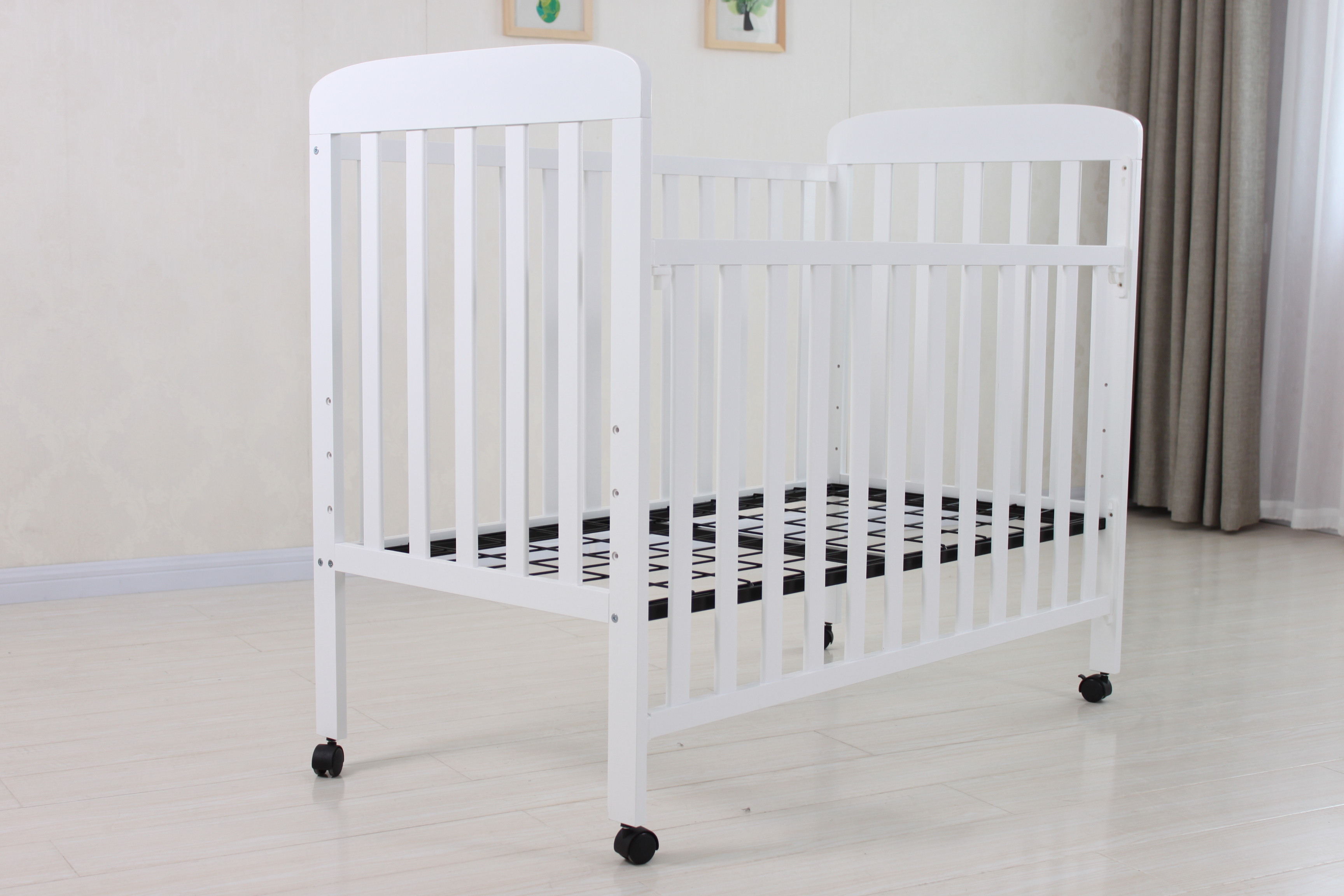
Many parents assume any bed rolling on casters is a travel bed. This assumption leads to immense frustration. We need to clarify the distinct role of wheeled furniture in your nursery planning.
Retailers often miscategorize a Baby Crib With Wheels as a portable crib. This mislabeling creates unrealistic expectations. A wheeled wooden crib offers mobility, but it completely lacks foldability. It gives you incredible flexibility inside your own home. It will not, however, fit into an airplane overhead bin.
You must separate indoor mobility from outdoor transit. Wheeled mini cribs allow parents to roll the baby from the master bedroom to the nursery. You can move them into the living room during the day without dismantling the frame. This makes daily life incredibly convenient.
Conversely, caster wheels do not make a crib suitable for car trunks. They do not prepare a bed for air travel. House-to-house transit requires collapsible joints. Room-to-room transit simply requires smooth-rolling casters.
If you choose a wheeled option, you must evaluate the hardware closely. Poorly designed wheels scratch hardwood floors and compromise stability.
Locking caster mechanisms: You need wheels locking securely in place. The bed must not shift when the baby pulls up to stand.
Floor-safe wheel materials: Look for rubberized wheels instead of hard plastic. Rubber prevents severe damage to expensive flooring.
Base width: The frame must easily clear standard 30-inch interior doorways. Always measure your doorframes before ordering a wheeled sleep solution.
Space and longevity dictate your best nursery investment. You must measure your available floor area accurately. You also need to understand how quickly your child will outgrow these specialized beds.
Standard cribs dominate room layouts. A standard crib measures roughly 28 by 52 inches. Mini cribs save you approximately 14 inches in length. This massive reduction opens up walkways in cramped apartments. It allows the bed to fit snugly beside a master suite nightstand.
Portable crib footprint variations require careful attention. Slanted legs on travel cribs often require more floor space than the mattress dimension implies. A travel crib might feature a 24-inch mattress. Yet, its flaring legs might demand a 32-inch floor footprint. Do not base your spatial planning solely on mattress size.
Children grow rapidly during their first two years. Your sleep furniture must safely accommodate their increasing height and weight.
Mini crib lifespan: Typically supports children up to 18–24 months. Most models max out safely when a child reaches 35 inches tall.
Portable crib lifespan: Often outgrown faster due to lower weight limits. Many feature floor-resting mattresses. Older babies easily climb out of shallow travel frames.
You must factor in secondary purchases when evaluating cost efficiency. Specific bedding becomes a hidden expense. You cannot stretch standard crib sheets over a mini mattress safely. You must buy specialized mini sheets.
Consider mattress upgrades carefully where legally compliant. Upgrading a wooden mini bed often requires a custom 5-inch thick mattress. Finally, calculate the potential transition timelines to a toddler bed. Since children outgrow mini options around age two, you will purchase a toddler bed sooner than you would with a full-sized convertible crib.
Chart: Dimensions and Lifespan Comparison | |||
Feature | Mini Crib | Portable/Travel Crib | Standard Crib |
|---|---|---|---|
Average Mattress Size | 24" x 38" | Varies (approx. 20" x 28") | 28" x 52" |
Estimated Floor Footprint | 25" x 39" | 30" x 40" (due to slanted legs) | 30" x 54" |
Average Lifespan | 18 - 24 Months | 6 - 18 Months | 3 - 4 Years |
Mattress Thickness | Up to 5 inches | Usually 1 - 2 inches | Up to 6 inches |
Safety overrides every other nursery decision. The Consumer Product Safety Commission (CPSC) governs strict guidelines for infant sleep environments. They evaluate permanent wooden structures differently than folding mesh play yards.
The CPSC mandates rigorous testing for rigid cribs. Inspectors drop heavy weights onto the mattress support system. They test slat spacing to ensure infant heads cannot get trapped. Wood or metal mini frames easily pass these high-impact tests. Folding mesh play yards undergo different evaluations. Testers focus heavily on hinge lock strength and breathable fabric standards. They ensure mesh walls will not suffocate an infant pressing against them.
The mattress presents the most severe hazard in compact sleep environments. Why are aftermarket mattresses a critical hazard in portable cribs? Travel beds utilize proprietary, ultra-thin pads for a specific reason. The soft mesh walls stretch slightly. If you insert a thick, rigid aftermarket mattress, the mesh walls flex outward. This creates a deadly gap between the mattress edge and the fabric wall. Infants can slip into this gap and suffocate.
Conversely, solid wood beds do not flex. Mini cribs generally accept standard 24"x38" mattresses up to 5 inches thick. Their rigid wooden slats eliminate wall-stretching. This allows for better long-term orthopedic support while completely avoiding the fatal mattress gap.
You must assess the structural integrity of folding hinges versus fixed bolts. Fixed bolts hold a wooden frame rigidly square. Over years of use, tight bolts resist wobble. Folding hinges inevitably develop slight play. Frequent packing and unpacking wear down locking mechanisms. Therefore, a bolted frame offers superior daily stability for an active toddler pulling up to stand.
We designed this framework to simplify your final purchase. Evaluate your lifestyle, home layout, and budget against these categorized recommendations.
Choose a Mini Crib If:
You have limited square footage but want a traditional nursery aesthetic.
You plan to use it daily for primary overnight sleep for 1.5+ years.
You want the option to use a thicker, standard-sized mattress.
Choose a Baby Crib With Wheels If:
You live in a single-story home or apartment.
You are following AAP room-sharing guidelines for the first 6 months but plan to move the crib to a nursery later without disassembling it.
You value sweeping and vacuuming underneath heavy nursery furniture easily.
Choose a Foldable Portable Baby Crib If:
You travel frequently, visit grandparents often, or need to store the crib in a closet daily.
You require a dual-purpose item serving as both sleep space and contained play area.
You lack the budget or space to commit to a permanent wooden structure.
Your ideal sleep solution strictly depends on how you balance mobility against longevity. The final verdict always comes down to "transit" versus "footprint." If you leave the house often, foldability wins. If you simply lack bedroom square footage, a scaled-down wooden frame serves you best.
We strongly recommend a clear next action step. Measure your primary doorways immediately if you are considering wheeled options. Evaluate your expected travel frequency over the next year before making a purchase. Knowing your exact interior doorway widths ensures your new rolling bed glides effortlessly from room to room. Making an informed choice today guarantees peaceful sleep for both you and your baby tomorrow.
A: Yes, but with strict limitations. CPSC guidelines approve many play yards for infant sleep. However, they lack long-term orthopedic support. The mandatory thin, firm mattress pads feel uncomfortable for heavier toddlers over time. You must never add a thick aftermarket mattress to a play yard, as this creates a fatal entrapment gap.
A: No, standard sheets will not fit safely. A standard crib sheet measures 28 by 52 inches. If you put it on a 24 by 38-inch mattress, the fabric becomes loose. Loose fabric presents a severe suffocation hazard. You must purchase specific mini or portable sheets designed exactly for your mattress dimensions.
A: We strongly advise against DIY modifications. Adding aftermarket wheels alters the bed's center of gravity. It creates serious balance and height risks. Drilling into the legs also instantly voids manufacturer warranties and safety certifications. We highly recommend buying a purpose-built baby crib with wheels designed explicitly for safe rolling.


