
- All
- Product Name
- Product Keyword
- Product Model
- Product Summary
- Product Description
- Multi Field Search


Views: 0 Author: Site Editor Publish Time: 2026-08-25 Origin: Site


While the soothing effect of rocking is a widely accepted neurological baseline, specific motion profiles vary drastically across products. This profile depends entirely on the physical geometry of the rocker blade. For parents evaluating a baby cradle investment, understanding the physics behind the sway is not just about aesthetics. It directly impacts daily safety, soothing efficacy, and mechanical longevity. You want a consistent, comforting rhythm rather than a jarring wobble. Choosing the wrong rocker arc often leads to poor sleep routines or premature floor wear. This guide breaks down how curve radius, center of gravity, and structural geometry dictate exact motion patterns. We provide a clear framework for evaluating your final product shortlist. You will learn how to match specific structural designs to your home environment effectively.
Every curved base essentially operates as a simple pendulum. The curvature of the rocker blade dictates how the structure interacts with gravity. We refer to this curvature as the arc radius. This mathematical measurement controls how the unit swings back and forth. You push the base, and kinetic energy fights against gravitational pull. The specific shape of the arc determines the resulting motion profile.
Understanding amplitude and frequency helps you predict the rocking experience. Amplitude refers to how far the base travels from its center resting point. Frequency refers to how many times it rocks back and forth within a minute. These two elements define the physical sensation experienced inside the basket.
Steeper or tighter curves produce high-frequency, short-amplitude rocking. The base changes direction rapidly. This creates a faster, slightly more abrupt motion. Flatter or shallower curves generate low-frequency, high-amplitude rocking. The base travels further before reversing direction. This delivers a longer, smoother, sweeping motion.
Many brands claim their specific frequency mimics the human womb. Biomechanical literature does study these biological rhythms. However, no single physical motion guarantees immediate infant sleep. Every child responds differently to sensory input. Your primary goal is finding mechanical consistency. You want to avoid unpredictable jerkiness. Smooth, predictable oscillations soothe the nervous system more effectively than erratic bumping.
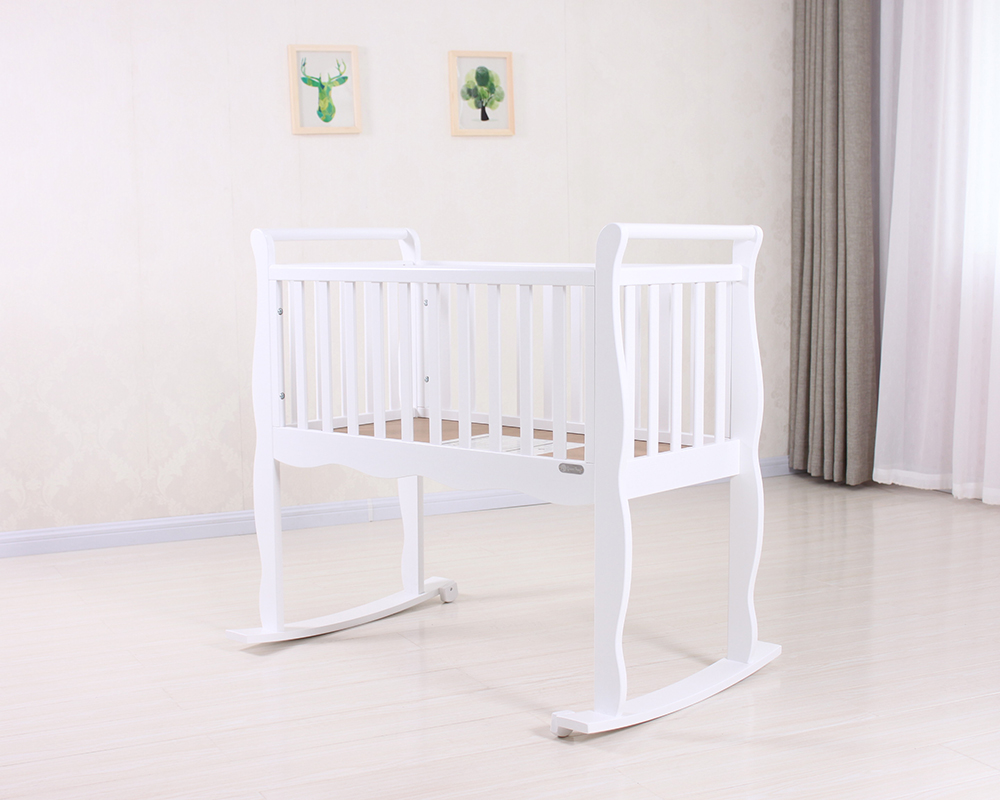
Manufacturers utilize various structural archetypes to achieve different swaying behaviors. The underlying shape heavily influences the final footprint and mechanical efficiency. We categorize these shapes into three primary design families.
This design utilizes parallel, elongated rocker runners. They closely resemble the bottom of a traditional winter sled. This geometry relies on a distinctly shallower curve. You get a highly smooth, linear glide. The movement usually runs side-to-side or head-to-toe across the floor.
A sled baby cradle works best for larger nurseries. It excels at low-frequency, sweeping soothing. The elongated base provides exceptional stability. However, it requires significantly more floor clearance than other models. The runners need unobstructed space to travel safely.
This archetype suspends the basket between two stationary pillars. Some variations feature a deep-arched traditional base. The motion profile relies on a pendulum-based swing. It does not utilize a floor-contact roll. The stationary legs remain firmly planted while the upper section glides.
Evaluating a French baby cradle reveals distinct advantages. It minimizes floor friction entirely. You will not hear squeaks on a hardwood surface. It creates a highly consistent, frictionless arc. This structure is ideal if you want a sustained, quiet rhythm.
Modern space-saving designs often use a cross-legged folding frame. These structures typically hold breathable fabric or mesh baskets. They do not use rigid floor rockers. Instead, they rely on fabric give and pivot-joint flexibility. The frame itself shifts slightly to generate a sway.
An X shaped baby cradle is ideal for tight spaces. It offers unmatched portability. You can fold it quickly for travel. However, the motion decay is quite rapid. The unit stops swinging quickly once you stop pushing. The folding joints absorb the kinetic energy instead of sustaining it.
The structural material carries the geometry. It heavily influences the longevity of the rocking motion. We call this kinetic energy transfer. When you push the frame, energy flows through the structure. Rigid materials preserve this energy. Flexible materials absorb and dissipate it.
Solid materials ensure minimal energy is lost to frame flexion. When a frame bends, it consumes the force you applied. Less force reaches the rocker blades. This results in shorter rocking durations. High structural rigidity translates your push directly into motion.
Wood offers exceptional rigidity. A properly joined wooden baby cradle minimizes energy loss effectively. The solid wood base maintains its oscillation longer. It vastly outperforms tubular plastic or thin aluminum frames. Once set in motion, it continues gliding with minimal effort. You do not have to push it constantly.
Implementation reality often differs from showroom expectations. The floor surface dictates how the geometry behaves. We must analyze these variables carefully.
Safety engineering relies heavily on physical geometry. A swinging basket deals with dynamic weight shifts. We must consider how the center of gravity interacts with the rocker base. Poorly designed arcs present significant tipping hazards.
Infants do not remain perfectly still. As they grow, they shift their body weight. They might roll to one side of the mattress. This lateral movement alters the structural center of gravity. The center of mass moves closer to the edge of the rocker blade. If the curve is too steep, gravity pulls the unit downward unexpectedly.
Engineers implement specific failsafes to counteract these weight shifts. These elements prevent the center of gravity from crossing the tipping threshold. Look for these safety mechanisms during your evaluation.
Mechanical Stops: Safety-compliant cradles integrate physical blocks. You will often see flat edges at the extreme ends of the rocker arc. These stops physically prevent the blade from rolling too far. They act as a hard brake against overturning.
The Tilt Limit: The industry uses standard safety thresholds for maximum tilt angles. Reputable brands calculate the exact point of no return. They design the arc to stop well before this threshold. Avoid exaggerated claims of a "100% tip-proof" design. Focus instead on verifiable design engineering that actively mitigates risk.
We strongly recommend verifying consumer safety certifications. Organizations like the CPSC and ASTM rigorously test these geometric boundaries. They use weighted dummies to simulate dynamic CoM shifts. They ensure the physical stops and tilt limits function correctly under stress. A certified unit guarantees the underlying physics are sound.
Choosing the right structural design requires balancing physics with your household environment. You must evaluate your flooring, available space, and desired aesthetic. We compiled a matrix to help you match these variables accurately.
| Primary Criteria | Recommended Archetype | Reasoning based on Geometry |
|---|---|---|
| Plush Carpets | Suspended / Glider (French) | Suspended structures avoid floor contact completely. They bypass friction dampening caused by deep fibers. |
| Maximum Portability | Folding Frame (X Shaped) | Pivot joints allow flat packing. You accept the trade-off of rapid motion decay for superior transportability. |
| Longevity & Aesthetics | Rigid Runners (Sled) | Solid wooden frames offer the most durable momentum transfer. Shallow curves provide sweeping, low-frequency soothing. |
You must inspect the structural geometry critically before purchasing. Keep an eye out for potential design flaws. These issues indicate poor engineering and potential safety risks.
A baby cradle is ultimately an engineered tool. The soothing motion you experience is directly tied to the physical geometry you purchase. Arc radius, structural archetypes, and frame materials work together to define the swaying performance. By understanding these mechanical principles, you can bypass marketing fluff. You can make an informed, evidence-based decision.
Your next step is practical assessment. Measure your available nursery floor space carefully. Assess your primary flooring material in that specific room. Finally, determine your top priority. Decide if you need the portability of a folding X-shape or the sustained motion of a solid sled runner. Use this specific criteria to confidently add the perfect option to your registry or cart.
A: Not necessarily. Deeper curves create faster, jerkier motions. Shallower curves offer the slow, sweeping motion most infants prefer.
A: Yes, but they can drift or cause wear. Look for geometry that includes felt or rubberized track strips along the bottom of the arc to increase grip and dampen noise.
A: This is a function of friction and weight distribution. Lightweight frames, flexible joints (like in folding models), or high-pile carpets absorb the kinetic energy, causing rapid motion decay.
A: Safety is driven by a wide base, a shallow arc, and engineered physical stops at the ends of the rocker blades that prevent the tilt from exceeding safety compliance angles.


