
- All
- Product Name
- Product Keyword
- Product Model
- Product Summary
- Product Description
- Multi Field Search


Views: 0 Author: Site Editor Publish Time: 2026-08-25 Origin: Site


Parents often face a stressful dilemma when preparing for family travel. You want space-saving convenience for sleep arrangements. However, you cannot compromise structural integrity or child safety. Toddlers are notoriously active sleepers. They roll, bounce, and constantly test the limits of their sleep gear. A collapsing frame poses a severe injury risk to your child. Understanding the mechanical realities of how a foldable toddler bed locks is a mandatory prerequisite for purchase. You must know exactly what keeps the frame upright and secure. Sleep environments demand rigorous safety standards. Our goal is to provide an evidence-based breakdown of these locking mechanisms. We will share specific evaluation criteria for structural safety. You will also learn practical steps to verify stability before every single use. This knowledge ensures peace of mind during your trips.
Any folding piece of furniture contains inherent structural vulnerabilities. Joints act as the primary weak points in these frames. Manufacturers must heavily engineer these specific areas to absorb repeated stress. They use heavy-duty hinges and reinforced brackets bridging these gaps. Without this reinforcement, the frame would buckle under active use. Safety framing requires us to look closely at these engineered joints. We must understand how they handle both downward pressure and lateral shifts.
Center of gravity distribution is a crucial factor in bed stability. Engineers calculate strict weight limits based entirely on a fully locked state. When the joints engage properly, they distribute weight evenly across the entire frame. An un-locked bed severely compromises this load-bearing capacity. If one hinge fails to lock, the weight shifts unevenly. The center of gravity moves off-balance, creating an immediate tipping or collapsing hazard. You must ensure all connection points distribute this weight as intended.
Ground contact plays a vital role in maintaining structural tension. Floor grips stop the bed legs from sliding outward on smooth surfaces. Angled legs maintain a continuous inward tension across the frame. This tension actually helps keep the bed locked securely. Active toddler movement pushes against this tension. When properly set up, this movement reinforces the stability of the lock. If the bed sits unevenly on the floor, it loses this critical tension. The locking mechanism then bears too much independent stress.
Not all locking mechanisms offer the same level of security. When you evaluate portable toddler furniture, you must understand the specific hardware involved. Different materials demand entirely different engineering solutions. Metal frames use different physics than fabric or wooden alternatives. We categorize these mechanisms into three distinct structural approaches.
You will frequently see push-button locks in metal frame designs. These use an internal spring to push a metal pin through a hole. Once the pin pops through, the joint locks solidly into place. Your primary evaluation criterion here is the release requirement. Look for dual-action release mechanisms. This means buttons must be pushed simultaneously or in a specific sequence. A dual-action requirement prevents accidental unlocking by a curious toddler. Single buttons are too easy for little fingers to manipulate.
Tension bars are standard in canvas or fabric-sided folding frames. They require you to physically stretch the fabric to click the bar into place. These latches must require adult-level force to lock properly. Gravity latches often work alongside tension bars. They rely on the sheer weight of the mattress to keep the mechanism engaged. If the mattress lifts, the tension drops. You must evaluate how securely the mattress integrates into the base. The fabric must remain taut to keep the joints locked.
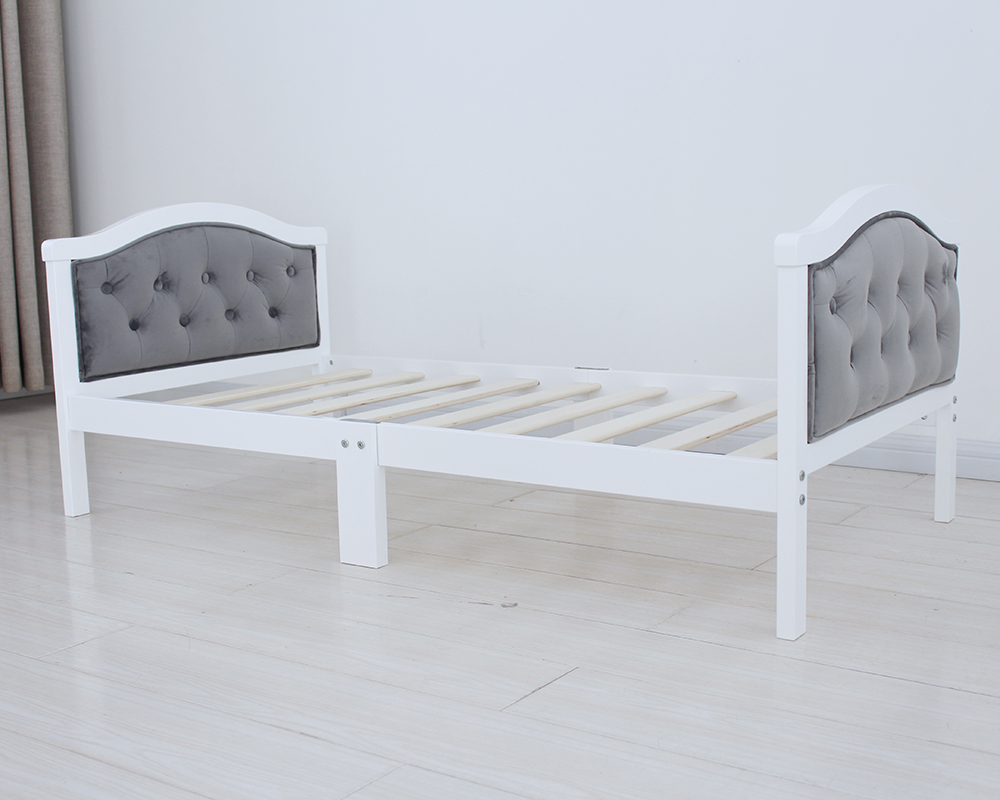
You typically find hinge brackets in a compact wooden toddler bed. Wood requires different fastening methods than hollow metal tubing. Slot systems use a drop-in method to secure the side rails. When evaluating these, you must check for metal-to-metal locking hardware. Wood-on-wood friction wears down quickly over time. Metal inserts at the wooden joints prevent wear-and-tear degradation. They ensure the lock remains tight even after hundreds of folding cycles.
Comparison of Locking Mechanisms
| Mechanism Type | Common Material | Primary Safety Feature | Evaluation Focus |
|---|---|---|---|
| Push-Button / Spring-Pin | Metal Tubing | Internal spring tension locking | Dual-action release requirement |
| Tension Bars / Gravity Latches | Fabric / Canvas | Mattress weight maintains lock | Requires adult-level force to engage |
| Hinge Brackets / Slots | Solid Wood / MDF | Drop-in structural bracing | Metal-to-metal hardware at joints |
Selecting a secure bed requires strict adherence to safety standards. You cannot rely on aesthetics or lightweight marketing claims. Evaluating a foldable children's bed demands a methodical approach. We must look at certifications, mattress integration, and built-in safety features. These elements dictate how well the locking mechanism performs under duress.
Regulatory compliance acts as your baseline safety metric. You must identify non-negotiable safety standards before purchasing. Look specifically for ASTM F406 compliance for non-full-size cribs and play yards. CPSC guidelines dictate strict testing for structural integrity and locking joint strength. Avoid unbranded imports lacking verifiable testing documentation. Counterfeit or deeply discounted models often cut corners on joint hardware. A failed lock is a catastrophic failure. Always demand transparent certification seals.
Many parents overlook how the mattress interacts with the frame. Mattress thickness and fit directly impact the lock's stability. A mattress that is too thick creates a dangerous leverage point. If a toddler rolls near the edge, a thick mattress acts like a fulcrum. It pushes against the side rails, stressing the locking joints outward. The mattress must fit snugly against all four sides. Gaps allow toddlers to wedge themselves, which can accidentally trigger release levers.
Active sleepers require built-in bed rails. You must evaluate how these rails interact with the folding mechanism. Do the rails compromise the structural fold? Ideally, they should lock independently of the main frame base. Some frames use the side rails as tension anchors. If a child leans heavily on these rails, the lock must hold firm. Test the rail hinges for any lateral wobble. Sturdy rails protect the child and reinforce the overall frame integrity.
Owning a certified bed is only half the safety equation. Setup errors cause the vast majority of structural failures. You must execute a flawless setup routine every single time. Trusting the mechanism implicitly is a mistake. Verification is an active, ongoing responsibility. We use specific techniques to ensure the hardware is fully engaged.
Manufacturers often tell you to listen for a "click". Hearing a click is only step one of the verification process. A partial lock can sound identical to a full lock. Users must visually inspect the hardware after hearing the sound. Look directly at the pin to ensure it sits fully inside its housing. Check that the hinge bracket sits completely flush. A small gap indicates the lock is jammed or only partially engaged. Never trust your ears alone; use your eyes.
Physical load testing reveals hidden weaknesses in the setup. You must perform this test before placing the mattress inside the frame. Follow these specific steps to verify structural integrity:
If you feel any shifting during this test, the bed is not secure. Break it down completely and restart the locking process.
We see recurring user-error risks during travel. Umbrella-style beds present a very specific setup challenge. You must lock the side rails firmly before pushing the floor down. If you push the floor down first, the sides will never lock properly. The tension becomes too tight. Another common failure involves ignoring secondary safety straps. Some models use velcro straps underneath the mattress to secure the folding joints. Failing to engage these straps leaves the primary lock vulnerable.
Hardware degrades over time through repeated folding and unfolding. You must actively manage this degradation to maintain safety. A folding toddler bed requires ongoing maintenance. Ignoring wear and tear invites sudden mechanical failure. We recommend establishing a strict inspection routine.
Internal metal springs eventually lose their tension. Wooden slots can splinter and warp due to humidity. We advise a comprehensive monthly inspection of all locking mechanisms. Add these quick checks to your routine:
If you notice any sluggish buttons or loose brackets, stop using the bed immediately.
Travel exposes portable gear to harsh environments. Sand, dirt, and sticky spills are common in vacation scenarios. These elements easily jam push-button locks and hinges. A jammed lock gives you a false sense of security. It might feel stiff, making you think it is locked. In reality, debris is preventing the pin from extending fully. Wipe down the joints with a damp cloth after outdoor use. Keep the locking tracks clear of all foreign materials.
Every piece of toddler gear has a strict expiration date based on child size. Define the absolute weight and height limits for your specific model. When a child exceeds these limits, the locking mechanism undergoes extreme stress. The frame may warp silently over time. If your toddler is tall enough to lean over the top rail, their center of gravity shifts dangerously. This signals that the folding mechanism is no longer safe. It is time to transition to a permanent bed.
The safety of a folding bed relies entirely on two factors. It is only as good as its locking mechanism and the user's diligence. A robust frame means nothing if parents fail to verify the locks. We must prioritize daily visual and physical inspections. Never assume the joints are secure just because they unfolded easily.
We strongly recommend prioritizing beds with dual-action locking mechanisms. Always demand verifiable safety certifications over pure aesthetic or lightweight appeal. A slightly heavier frame often indicates higher quality locking hardware. Structural integrity must always outrank travel convenience.
Take immediate action before you finalize your purchase. Cross-reference your shortlisted beds against CPSC recall databases. Verify that the locking mechanisms have no history of mechanical failure. Educate anyone who cares for your child on the proper setup sequence. Vigilance keeps your toddler safe and ensures peaceful nights while traveling.
A: A well-designed bed prevents this through dual-action locks. These require pressing two buttons simultaneously, which exceeds a toddler's hand span and coordination. Furthermore, manufacturers intentionally place primary locking mechanisms under the mattress or outside the fabric walls. This keeps the hardware completely out of the child's reach.
A: Yes, provided they use metal-to-metal joint hardware. Wood is incredibly sturdy and distributes weight excellently. However, wooden slots without metal reinforced brackets will degrade from friction. Metal tubing relies on spring tension, while wood relies on drop-in gravity brackets. Both are highly secure if they meet ASTM compliance.
A: Cease using the bed immediately. A lack of clicking indicates a broken internal spring, bent pin, or jammed track. Do not attempt DIY fixes on tension or locking parts. Makeshift repairs cannot replicate factory-calibrated load-bearing standards. Contact the manufacturer for replacement parts or discard the frame entirely.
A: Most designs integrate a low-profile frame geometry alongside locking side rails. The mattress sits deeply inside a protective outer shell. If the child rolls against the fabric or rails, the tension distributes into the locked corner joints. This securely contains the child without stressing a single pressure point.


