
- All
- Product Name
- Product Keyword
- Product Model
- Product Summary
- Product Description
- Multi Field Search


Views: 0 Author: Site Editor Publish Time: 2026-08-20 Origin: Site


Infant sleep safety relies on strict, continuously evolving international regulations. Procuring compliant sleep environments is a high-stakes decision for institutions and households alike. Buyers face a saturated market where aesthetic marketing obscures technical safety flaws. This makes it difficult to differentiate between baseline compliance and rigorous, long-term structural integrity. Relying solely on visual appeal or basic product descriptions leaves vulnerable infants at risk. We provide a technical evaluation framework to assess critical safety features, verify compliance credentials, and confidently select reliable sleep structures. By understanding the mechanical tolerances, material science, and regulatory mandates behind infant sleep furniture, you can implement procurement and maintenance protocols that ensure long-term hazard prevention and absolute structural reliability.
Structural Dimensions are Non-Negotiable: Safe cots require exact slat spacing (maximum 2 3/8 inches or 60mm) and flush corner posts to eliminate entrapment and strangulation risks.
Mattress Fit Dictates Safety: A firm, flat, and breathable sleep surface with zero gap tolerance between the mattress and the frame is mandatory to mitigate SIDS and suffocation hazards.
Chemical and Material Transparency: High-quality units utilize verifiable non-toxic, low-VOC finishes and bite-resistant materials, requiring documentation from a certified baby cot manufacturer.
Commercial Durability Requires Stricter Vetting: Purchasing commercial baby furniture for high-turnover environments (nurseries, hotels) demands enhanced hardware stability, rigorous supplier compliance auditing, and strict maintenance protocols.
Failing to verify regional safety certifications leads to product recalls, severe liability issues, and immediate physical hazards. The regulatory landscape demands rigorous documentation and independent laboratory verification. Manufacturers must adhere to strict testing protocols that simulate years of dynamic load stress, environmental wear, and infant interaction. You cannot rely on visual inspections to confirm compliance; you must audit the engineering data.
Different global regions enforce specific legal requirements for infant sleep environments. In North America, the Consumer Product Safety Commission (CPSC) and ASTM F1169 mandate rigorous structural testing. This includes dynamic impact tests on side rails and torque tests on all fasteners to ensure they do not loosen under vibration. Europe relies on EN 716, which dictates strict dimensional tolerances, material safety thresholds, and bite-testing protocols. Australia and New Zealand utilize AS/NZS 2172, focusing heavily on preventing entrapment hazards and ensuring base stability under active infant movement.
A major historical shift across all these frameworks is the absolute ban on drop-side mechanisms. Historically, drop-side hardware suffered from high failure rates. Plastic tracks warped under temperature changes, and hidden screws loosened over time. This created a dangerous gap between the mattress and the side rail, leading to fatal entrapment. Current international standards mandate rigid, fixed-side construction to maintain absolute structural integrity and eliminate moving parts that degrade.
Regional Safety Standard Specifications
Regulatory Standard | Region | Primary Focus Areas | Key Testing Protocols |
|---|---|---|---|
CPSC / ASTM F1169 | North America | Structural integrity, hardware durability, fixed-side mandate | Dynamic impact testing, torque/tension tests on fasteners |
EN 716 | Europe | Dimensional tolerances, material toxicity, entrapment prevention | Bite testing, chemical emission analysis, gap measurement |
AS/NZS 2172 | Australia / New Zealand | Base stability, mattress fit, hazard elimination | Slat flexibility testing, mattress base load testing |
Auditing a manufacturer’s compliance documentation requires a systematic approach. You must request third-party lab testing certificates and ISO manufacturing certifications. Authentic documentation clearly states the specific standard tested, the date of testing, and the accredited laboratory's credentials. Working directly with a certified baby cot manufacturer ensures the unit undergoes rigorous physical and chemical evaluation before reaching the market.
Watch for distinct red flags in supplier documentation. Expired certificates, self-certified claims without independent laboratory backing, and opaque supply chains indicate severe compliance risks. A legitimate manufacturer provides full traceability for their materials, from the sourcing of the timber to the chemical composition of the final topcoat. They will readily supply gas chromatography reports proving their finishes meet heavy metal and VOC emission limits.
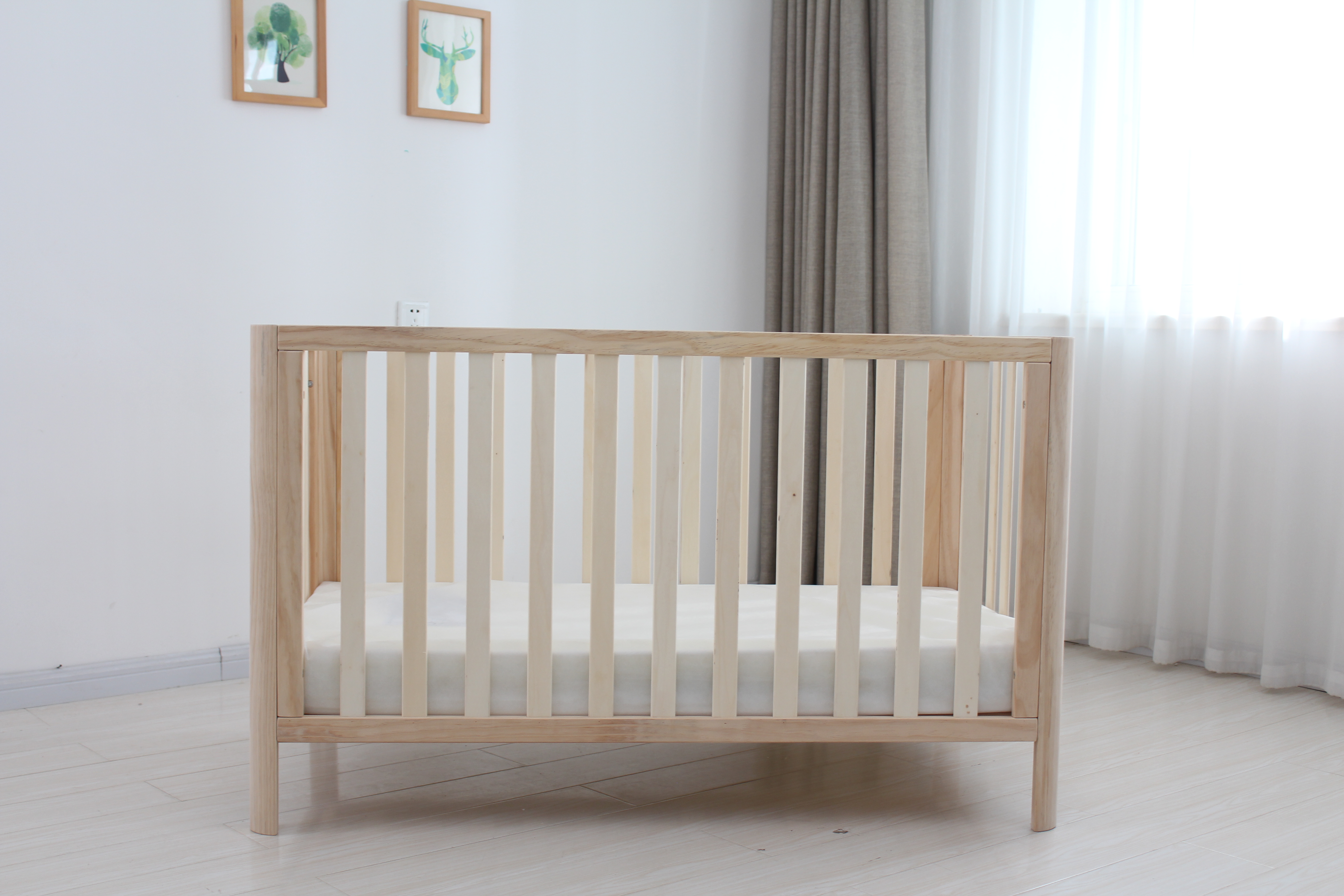
Evaluating the physical architecture of the frame ensures it withstands dynamic loads and prevents physical entrapment. The geometry of the frame, the quality of the joining mechanisms, and the spacing of the vertical barriers dictate the overall safety profile of the unit. Wood density and hardware selection play massive roles in long-term stability.
The technical specification for slat spacing is universally strict: slats must be no more than 2 3/8 inches (60mm) apart. This exact measurement prevents an infant's body from slipping through while trapping their head, which constitutes a critical strangulation hazard. Even a millimeter of deviation compromises the safety of the sleep environment.
Manufacturers utilize specific testing methodologies to ensure these gaps remain constant. Engineers apply a wedge block test to measure slat flexibility. They force a standardized wedge between the slats at a specific pressure. If the slats bow or bend, the gaps widen, creating temporary entrapment risks. High-quality construction utilizes dense hardwoods like kiln-dried beech or reinforced engineered materials that resist bowing. Softwoods like untreated pine often fail this test after a few months of environmental humidity changes.
Assessing the quality of metal inserts, bolts, and locking mechanisms is vital. Wood-on-wood threading is a critical failure risk. Wood fibers strip and loosen with seasonal humidity changes and mechanical vibration. Superior designs utilize machine screws paired with metal cross-dowel barrel nuts or threaded metal inserts. This provides a secure, metal-on-metal connection that maintains high tension without degrading the surrounding timber.
Corner posts require specific engineering to mitigate strangulation risks. Posts must be completely flush with the end panels. If a post extends above the top rail, it creates a catch point for clothing, pacifier clips, or sleep sacks. For specific designs like canopy beds, posts must exceed 16 inches to ensure they are entirely out of reach of the infant.
The hardware integrity rule is absolute: units must feature zero missing, loose, broken, or improperly installed screws. Makeshift or DIY hardware repairs are strictly prohibited. Substituting OEM hardware with generic hardware store bolts alters the tension dynamics of the frame and voids all safety certifications.
Follow these steps to verify hardware integrity during assembly:
Inventory all hardware against the manufacturer's manual before beginning assembly.
Inspect threaded inserts inside the wood panels to ensure they are seated flush and straight.
Apply the manufacturer-provided thread locker if specified in the instructions.
Tighten all bolts to the specified torque limit, avoiding over-tightening which can crack the timber.
Perform a shake test on the assembled frame to identify any loose joints or rattling components.
Adjustable bases accommodate different developmental stages, from a newborn to a standing toddler. The highest setting reduces strain on caregivers when lifting infants, while the lower settings prevent toddlers from climbing out. Base stability relies on reinforced metal brackets and heavy-duty springs or solid wooden slats. Avoid units that use brittle plastic clips to hold the mattress base, as these snap under sudden loads.
Implementing adjustable heights carries a specific risk regarding depth. The lowest setting must provide sufficient depth—a minimum of 26 inches from the top of the mattress support to the top rail. This critical dimension prevents climbing falls once the infant develops the motor skills to pull up to a standing position.
The interplay between the frame and the mattress is a primary vector for sleep safety. A structurally perfect frame paired with an incompatible or substandard mattress creates immediate suffocation and entrapment hazards. You must evaluate the sleep surface with the same rigor as the wooden frame.
Mattresses must resist indentation completely. Soft surfaces, memory foam, and inclined sleepers restrict infant airways and exponentially increase the risk of Sudden Infant Death Syndrome (SIDS). The sleep surface must remain perfectly flat and rigid. If an infant rolls over, their nose and mouth must not be obstructed by sinking material. High-density foam or heavy-gauge innerspring cores provide the necessary resistance.
Advanced mattress designs incorporate breathable materials to promote airflow, further reducing suffocation risks and regulating infant body temperature. Overheating is a known risk factor for SIDS, making thermal regulation a critical component of mattress engineering. Regulatory alignment strictly follows the "ABCDs of sleep": infants must sleep Alone, on their Back, in a Crib, in a Danger-free environment.
The "two-finger rule" dictates dimensional compatibility. If more than two fingers fit between the mattress and the side rail, the risk of wedging and suffocation is too high. The mattress must fit snugly against all four interior walls of the frame, leaving zero tolerance for shifting during use.
Sourcing the mattress and the frame from the same manufacturer guarantees dimensional compatibility and eliminates edge-gap hazards. When evaluating Cots, always verify the internal dimensions of the frame against the exact specifications of the mattress. Do not rely on generic labels like "standard size," as manufacturing variances between different brands result in dangerous gaps.
Mattress Fit Troubleshooting Guide
Observed Issue | Potential Hazard | Required Action |
|---|---|---|
Gap larger than two fingers at the edges | Infant wedging and suffocation | Replace mattress with exact OEM dimensions. |
Mattress compresses easily under hand pressure | Airway obstruction, SIDS risk | Upgrade to a high-density, firm core mattress. |
Fitted sheet pulls mattress corners up | Uneven sleep surface, rolling hazard | Use correctly sized sheets; ensure mattress rigidity. |
Balancing aesthetic finishes with non-toxic, durable materials requires a deep understanding of chemical emissions and material degradation. Infants interact with their environment using their mouths. The chemical composition of the frame is just as important as its physical structure.
Identifying heavy-metal-free paints, lead-free varnishes, and Greenguard Gold certification for low chemical emissions is a mandatory evaluation dimension. Volatile Organic Compounds (VOCs) off-gas from synthetic finishes and adhesives, degrading indoor air quality and posing respiratory risks to developing lungs. Certified finishes undergo chamber testing to ensure emissions remain well below hazardous thresholds.
You must weigh the trade-offs between solid wood and engineered wood (such as MDF or plywood) regarding formaldehyde off-gassing and structural longevity. High-quality engineered woods offer excellent dimensional stability and resistance to warping, but they rely on adhesives that must be rigorously tested for formaldehyde emissions. Solid hardwoods naturally avoid adhesive off-gassing and offer superior screw retention, though they require meticulous kiln-drying to prevent moisture-induced cracking.
Key requirements for safe finishes include:
Water-based, non-toxic paints that comply with ASTM F963 for heavy metal limits.
Clear coats that do not yellow or become brittle under UV exposure.
Adhesives in engineered wood components that are certified CARB Phase 2 compliant for formaldehyde emissions.
Finishes that cure completely before packaging to prevent trapped off-gassing in the box.
Non-toxic, shatter-proof plastic teething guards protect both the infant's teeth and the structural integrity of the wood. As infants develop, they frequently chew on the top rails. Without protection, this biting splinters the wood, creating choking hazards and allowing moisture from saliva to penetrate the finish, which degrades the timber.
Teething rails must be securely integrated into the design, utilizing non-toxic, phthalate-free plastics. They must resist cracking under pressure and remain firmly attached to the rail, ensuring no small plastic fragments break loose and pose an ingestion risk.
Units used in daycares, hospitals, or hotels undergo significantly higher stress and sanitation cycles than residential models. The procurement strategy for institutional environments must prioritize heavy-duty construction, chemical resistance, and rapid mobility.
Institutional success criteria require enhanced load-bearing capacities, commercial-grade casters with dual-locking mechanisms, and reinforced mattress supports. Frequent relocation across different floor surfaces places immense lateral stress on the joints. Casters must feature polyurethane wheels that resist shattering, paired with heavy-duty metal stems that distribute weight evenly across the corner posts.
Sanitation requirements in high-traffic environments are severe. Materials must withstand hospital-grade disinfectants and frequent wipe-downs without degrading the non-toxic finish or compromising structural joints. When procuring commercial baby furniture, request chemical resistance data for the topcoat. Ensure the finish will not peel, blister, or become tacky after repeated exposure to bleach-based or alcohol-based sanitizers.
Residential vs. Commercial Specification Comparison
Feature | Residential Standard | Commercial Requirement |
|---|---|---|
Mobility | Stationary or light-duty plastic casters | Heavy-duty polyurethane casters with dual locks |
Sanitation | Mild soap and water resistance | Hospital-grade chemical disinfectant resistance |
Hardware | Standard barrel nuts and bolts | Reinforced steel brackets, tamper-proof fasteners |
Evacuation | Standard doorway clearance not required | Must fit through standard commercial fire doors |
Establishing service-level agreements (SLAs) for replacement parts, warranty terms, and batch-testing verification is essential to ensure uniform safety across large orders. Institutional buyers cannot afford downtime caused by broken hardware or degraded components.
A reliable safety baby cot supplier provides transparent audit trails for every production run. This includes guaranteed access to OEM replacement parts for the lifespan of the product. Using generic replacement parts in a commercial setting violates safety compliance and transfers immense liability to the institution.
A structurally perfect unit becomes hazardous if assembled incorrectly, poorly maintained, or placed in a dangerous environment. Safety is an ongoing operational process, not just a one-time procurement checklist. Facility managers and parents must control the surrounding environment.
Strict adherence to Lullaby Trust and CPSC guidelines requires an entirely empty sleep environment. No bumpers, soft toys, pillows, sleep positioners, or heavy blankets should ever be placed inside the unit. These items exponentially increase suffocation risks, restrict airflow, and act as stepping stools for older infants to climb over the rails.
The sleep surface must contain only a tightly fitted sheet over a firm mattress. Any deviation from this rule introduces unnecessary environmental hazards that compromise the engineered safety features of the frame.
Second-hand or custom-built units lack verifiable compliance certificates, feature degraded hardware, or utilize outdated, banned designs like drop-sides. Micro-fractures in the wood, stripped screw threads, or compromised joints are invisible to the naked eye but drastically reduce the unit's ability to withstand dynamic loads.
The procurement standard must remain strict: always source new units from certified manufacturers to guarantee current regulatory compliance and access to OEM replacement parts. DIY construction lacks the rigorous laboratory testing required to verify slat flexibility, chemical toxicity, and fastener torque limits.
Installation guidelines dictate positioning units away from windows, blind cords, radiators, and wall-mounted monitors. Blind cords present a severe strangulation hazard. Proximity to radiators causes infant overheating and accelerates the degradation of wooden joints due to localized humidity drops.
Follow these environmental placement rules:
Maintain a minimum clearance of three feet from any window or blind cord.
Position the unit away from direct airflow of HVAC vents to prevent drastic temperature fluctuations.
Ensure no wall-mounted baby monitors or electrical cords are within arm's reach of the frame.
Keep the unit away from heavy wall decor or shelving that could fall during seismic activity.
Implementing routine maintenance schedules is mandatory. Caregivers and facility managers must check for loosened bolts, compromised joints, or missing hardware post-assembly. A monthly torque check on all metal fasteners ensures the frame maintains its structural rigidity, preventing the development of dangerous gaps over time.
Request current compliance certificates (CPSC, EN 716, or AS/NZS 2172) directly from the manufacturer's compliance officer before finalizing any purchase order.
Measure the internal dimensions of the assembled frame and cross-reference them with the mattress specifications to guarantee a zero-gap fit.
Implement a standardized monthly maintenance schedule to verify fastener torque, inspect caster locks, and check teething rails for hairline fractures.
Establish a clear service-level agreement with your supplier to guarantee access to OEM replacement hardware for a minimum of five years.
A: The maximum safe distance between slats is 2 3/8 inches (60mm). This strict dimensional tolerance prevents an infant's body from slipping through the gaps, which eliminates the risk of their head becoming trapped, a primary cause of strangulation.
A: Drop-side mechanisms are banned internationally because the moving hardware is prone to wear, warping, and failure. When the tracks or screws degrade, a dangerous gap forms between the mattress and the side rail, creating a severe entrapment and suffocation hazard.
A: Request third-party laboratory testing certificates and ISO manufacturing credentials. Authentic documents list the specific safety standard tested, the date of the test, and the accredited independent laboratory that performed the evaluation.
A: The two-finger rule is a manual check for dimensional compatibility. If you can fit more than two fingers between the edge of the mattress and the interior side of the frame, the gap is too large, posing a critical wedging and suffocation risk.
A: Yes, teething rails protect both the infant and the furniture. They prevent infants from ingesting wood splinters or toxic finishes while chewing on the top rail. They also protect the wood from moisture damage caused by saliva.
A: Hardware should be inspected at least once a month. Caregivers or facility managers must check for loose bolts, missing screws, and compromised joints, tightening any metal fasteners to ensure the frame maintains its rigid structural integrity.


