
- All
- Product Name
- Product Keyword
- Product Model
- Product Summary
- Product Description
- Multi Field Search


Views: 0 Author: Site Editor Publish Time: 2026-07-30 Origin: Site


The safety and longevity of a crib are rarely determined by its surface finish or aesthetic design, but rather by the invisible mechanical connections holding the frame together. Toddlers subject cribs to severe, repetitive dynamic loads—shaking, jumping, and leaning. Poorly designed joints in manufactured furniture inevitably loosen, creating wobbles, squeaks, and critical safety hazards over time. To confidently invest in a safe sleep environment, buyers must look past the marketing terminology and evaluate the specific joinery techniques, hardware quality, and wood species used in the crib's construction. We see this constantly in the field; a beautiful finish often hides weak dowels that snap under lateral pressure. Understanding the mechanics of these connections ensures you select a frame built to withstand years of daily abuse without compromising structural integrity.
Mortise and tenon joinery remains the structural gold standard for maximizing the lifespan and rigidity of a solid wood baby crib.
Wood density dictates joint performance: Fasteners and dowels behave differently under stress in hardwoods (oak, beech) compared to softwoods (pine).
Hardware integration matters: Hidden hardware prevents tampering and snagging, but must utilize metal-to-metal inserts rather than screws driven directly into end-grain wood.
Convertibility introduces stress: A wooden cot bed designed to transition into a toddler bed requires robust, re-tightenable joints to survive multiple disassemblies.
Leverage and rail height: Lower-profile side rails reduce the physical lever arm, decreasing the rotational torque exerted on base joint connections during dynamic movement.
A durable joint must resist shear force, side-to-side racking, and tension without relying solely on chemical adhesives. Daily wear-and-tear degrades weak connections rapidly. When a child shakes the rails, they apply continuous racking stress. Parents leaning over the mattress support add sudden, heavy weight loads. A well-engineered wooden baby crib anticipates these forces through mechanical design rather than just surface glue.
Taller side rails act as longer lever arms. This physical reality increases the rotational torque on lower joints. Low-profile designs naturally reduce structural fatigue because they minimize the racking stress applied to base connections. Wood movement also plays a massive role in joint longevity. Seasonal changes in humidity cause wood to expand and contract across the grain. This natural shifting compromises rigid glued joints if they lack proper mechanical interlocking.
To understand how these forces break down furniture, consider the specific failure points we observe during structural testing:
Shear Failure: The hardware snaps or the wood splits horizontally when sudden downward force is applied to the mattress support.
Racking Degradation: Side-to-side shaking slowly crushes the wood fibers around a metal screw, enlarging the hole until the rail wobbles freely.
Tension Pull-Out: Direct-thread screws pull straight out of end-grain wood when a child pushes outward on the spindles.
Adhesive Fracture: Brittle wood glue cracks under dynamic vibration, leaving only weak secondary fasteners to hold the frame together.
Manufacturers must engineer joints that account for all four of these failure modes simultaneously. Relying on a single point of connection, like a basic wood screw, guarantees eventual failure under toddler-induced dynamic loads.
Traditional mortise and tenon joints offer unmatched strength. They utilize an interlocking wood-to-wood connection that maximizes glue surface area and mechanical rigidity. Manufacturers use this method for factory-assembled components, perfectly connecting mattress frame rails to solid end panels. Because the tenon is cut directly from the rail and fits snugly into the mortise, the joint resists racking forces exceptionally well.
Dowel joinery is highly common in a standard wooden cot. Cylindrical wooden pegs insert into corresponding alignment holes. However, this method fails under specific conditions. Undersized or un-grooved dowels weaken the structure. If the glue degrades under continuous racking stress, the joint pulls apart. Dowels work best as alignment aids rather than primary load-bearing connectors.
Commercial knock-down (KD) fasteners represent modern flat-pack engineering. Threaded steel bolts mate with cross-dowels or barrel nuts embedded inside the wood. When executed correctly with metal-to-metal components, these fasteners deliver incredibly strong joints. They remain exceptionally easy for the end-consumer to assemble and disassemble. They prevent stripping the wood fibers during setup, which is a massive advantage for convertible furniture.
Joint Type | Primary Application | Load Resistance | Reassembly Capability |
|---|---|---|---|
Mortise and Tenon | Factory-assembled end panels | Excellent against racking and shear | None (Permanent) |
Wooden Dowels | Alignment and secondary support | Moderate (relies heavily on glue) | Poor (Glue breaks down) |
Cross-Dowel / Barrel Nut | User-assembled side rails | High tension and shear resistance | Excellent (Metal-to-metal) |
Direct Wood Screws | Cheap, low-quality frames | Low (Strips easily over time) | Very Poor |
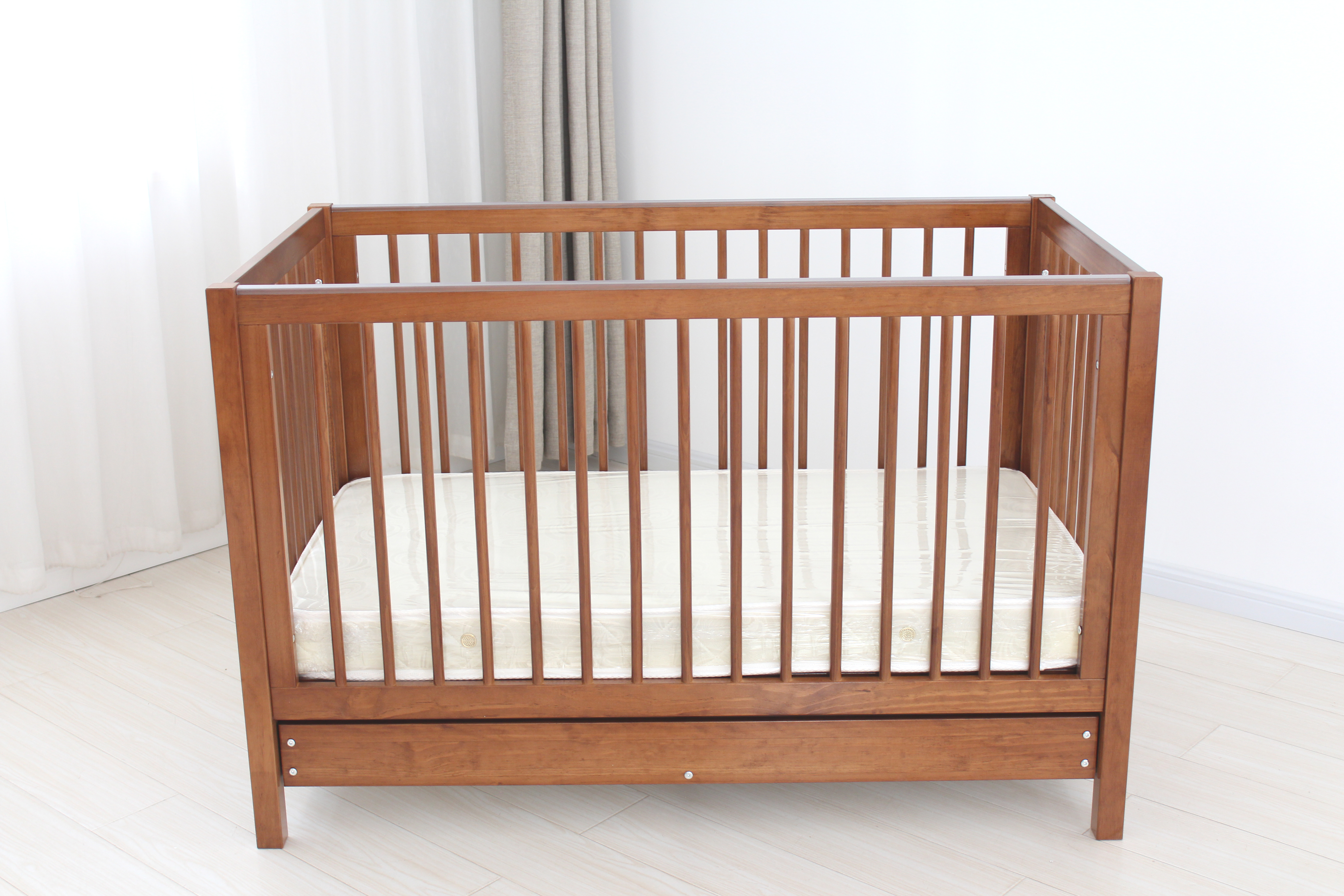
Wood density directly dictates joint performance over time. Hardwoods like oak, maple, birch, and beech offer superior structural integrity. Their high density prevents metal fasteners from crushing the wood fibers. This supports highly rigid mortise and tenon joints and holds screw threads securely. Hardwoods remain the premier choice for a long-lasting solid wood baby crib. The tight grain structure resists the localized compression caused by heavy steel bolts.
Softwoods present different engineering challenges. Pine is lightweight and highly cost-effective, making it popular for nursery furniture. However, its cellular structure compresses easily under localized loads. A durable pine wood baby crib must avoid direct-thread wood screws entirely. It must utilize oversized joint interfaces and thicker structural spindles. Cross-dowel hardware is essential here. It distributes stress across a wider surface area, preventing the soft pine from splitting or stripping out.
When evaluating wood species, you must match the hardware to the material. Driving a coarse-thread screw into oak might split the wood if not properly pre-drilled, while driving that same screw into pine might hold initially but strip out after a few months of racking. Metal-to-metal inserts solve this problem across all wood types by isolating the threads from the wood fibers entirely.
Hidden hardware provides clear aesthetic and safety benefits. It prevents toddlers from accessing, picking at, or loosening screws with their fingers. It eliminates sharp, exposed metal edges, preventing snagging on sleeping garments or scratching sensitive skin. The crib maintains a clean, seamless appearance that many parents prefer for modern nursery designs.
However, hidden hardware introduces a maintenance trade-off. It can be difficult to access for routine safety inspections. Tightening internal bolts requires more effort and sometimes specialized tools. Scalability is also a concern. When converting a wooden cot bed to a toddler bed, hidden fasteners must align perfectly. Precision machining is required to prevent cross-threading during reassembly. If the factory tolerances are off by even a millimeter, hidden hardware becomes a nightmare to assemble.
Exposed fasteners, while less aesthetically pleasing, offer straightforward maintenance. You can visually inspect a bolt head to see if it has backed out. You can easily apply a hex wrench to torque it down. For exposed hardware, manufacturers should use rounded, low-profile bolt heads and recess them slightly into the wood to mitigate snagging risks.
Buyers must identify glued-only versus mechanically fastened joints. Reject cribs that rely entirely on surface glue, staples, or brad nails. These are unacceptable for critical load-bearing connections. Assess spindle integration carefully. Vertical slats must seat deeply into routed grooves in the top and bottom rails. Avoid cribs where slats are merely pinned in place with surface-level fasteners, as a swift kick from a toddler can dislodge them.
Vibration-resistant hardware is non-negotiable. Evaluate if assembly bolts feature nylon-patch locking threads. Lock washers also prevent self-loosening from continuous baby-induced vibration. Verify regulatory compliance before purchasing. The joint design must meet or exceed structural testing standards for dynamic impact and side-rail strength.
Follow these inspection steps when evaluating a frame:
Check the end panels for visible mortise and tenon joints or heavy dowel construction.
Inspect the hardware pack for barrel nuts and machine bolts rather than pointy wood screws.
Push laterally on the assembled floor model to test for excessive racking or squeaking.
Examine the mattress support brackets to ensure they bolt through the frame rather than hanging on small screws.
Review the assembly manual online before purchasing to verify the exact hardware types used.
Establish a bi-annual maintenance schedule to check and torque all accessible fasteners.
Inspect the spindle grooves upon delivery to ensure slats are deeply tenoned into the rails.
Retain all original tools and spare cross-dowels provided by the manufacturer for future conversions.
A: The mortise and tenon joint is the strongest connection for factory-assembled parts. For user-assembled sections, metal-to-metal barrel nuts combined with steel bolts provide the highest durability and resistance to racking.
A: Yes, provided they use the correct hardware. Because pine is a softer wood, the crib must use cross-dowel fasteners rather than screws driven directly into the wood to prevent stripping and splitting.
A: Wobbling usually results from loose hardware or degraded wooden dowels. You can fix this by tightening all metal fasteners. If the wobbling persists, the internal dowel joints may have failed, requiring professional repair.
A: Hidden hardware is safer because it prevents toddlers from tampering with screws and eliminates snag hazards. However, it requires precision manufacturing to ensure it aligns correctly during assembly.
A: Joints hold up well if they utilize metal threaded inserts. If the bed uses direct wood screws, the holes will strip after one or two disassemblies, compromising structural integrity.
A: Look for metal barrel nuts, thick alignment dowels, and nylon-coated locking threads on the bolts. Avoid any flat-pack crib that requires you to drive screws directly into unthreaded wood.
A: Yes. Taller side rails create a longer lever arm. When a child shakes a tall rail, it applies significantly more rotational torque to the bottom joints compared to a lower-profile design.


