
- All
- Product Name
- Product Keyword
- Product Model
- Product Summary
- Product Description
- Multi Field Search


Views: 0 Author: Site Editor Publish Time: 2026-09-16 Origin: Site


Expecting parents face a massive volume of newborn sleep products. Building a nursery often turns into a stressful puzzle where safety regulations and sheer exhaustion collide. During the fourth trimester, you must balance strict safe-sleep requirements with the physical toll of postpartum recovery. You need sleep solutions that offer uncompromising safety alongside extreme convenience.
This raises a practical question: is a dedicated, mobile sleep space a functional necessity, or just a redundancy your baby will quickly outgrow? We will objectively evaluate whether investing in a mobile infant bed makes sense for your household layout, travel habits, and daily routines. By stripping away the marketing noise, you can determine exactly what gear you actually need to survive the first few months of frequent overnight feedings and fragmented sleep.
Short Lifespan vs. High Utility: A bassinet is typically outgrown within 4 to 6 months, but its value peaks during the first 12 weeks of frequent overnight feedings and parental recovery.
Mobility is the Primary Differentiator: The ability to safely move a sleeping space throughout the house, or pack it for air and road travel, defines the ROI of a portable model compared to stationary cribs.
Safety is Non-Negotiable: Any bassinet considered must meet current CPSC regulations and align with AAP safe sleep guidelines (firm, flat surface without loose bedding).
Lifestyle Dictates Necessity: Families who travel frequently or live in multi-level homes gain the most value; those in smaller, single-level spaces may find a standard crib or pack-and-play sufficient.
Newborns sleep up to 17 hours a day in short, unpredictable bursts. A stationary crib confines that sleep to a single room. This rarely aligns with the reality of daily household tasks. The primary functional purpose of a room to room bassinet is keeping your infant within arm's reach during both daytime naps and overnight stretches. This proximity allows you to monitor breathing, respond to early hunger cues before crying escalates, and maintain your own mobility around the house.
To succeed in this role, the unit must meet specific operational criteria. A lightweight frame is essential for easy lifting over thresholds or area rugs. Locking wheels provide the necessary mobility to glide from the bedroom to the living room without waking a sleeping baby. Furthermore, the footprint must be narrow enough to navigate standard interior doorways. Most interior residential doors measure between 30 and 32 inches wide. If the frame requires tilting or partial disassembly to move between rooms, it fails its primary purpose. You also need to consider the turning radius. A model with four swivel casters will navigate tight hallway corners much easier than a model with only two fixed wheels.
Convenience can never supersede safety when selecting infant gear. The American Academy of Pediatrics (AAP) strongly recommends room-sharing without bed-sharing for at least the first six months of life. Having a dedicated Bassinet right next to the adult bed facilitates this guideline perfectly. Room-sharing reduces the risk of Sudden Infant Death Syndrome (SIDS) by up to 50% compared to solitary sleeping in a separate nursery.
Simultaneously, the Consumer Product Safety Commission (CPSC) enforces strict structural requirements for these products. Any model you consider must feature a firm, flat mattress pad. The pad cannot indent under the baby's weight. Mesh sides are mandatory for breathability. If the infant rolls against the side, airflow must remain unobstructed. The base must be highly stable, passing rigorous tip-over testing to ensure that siblings or pets cannot easily knock the structure over. Always verify that your chosen model carries a recent CPSC certification. This indicates compliance with the latest safety mandates. You should also check for JPMA (Juvenile Products Manufacturers Association) certification, which often tests above and beyond basic federal requirements.
The most common argument against buying newborn-specific sleep gear is its notoriously short lifespan. Strict developmental milestones dictate exactly when usage must end. You must transition your baby to a full-sized crib or playard the moment they reach the manufacturer's weight limit. This limit usually sits between 15 and 20 pounds. More importantly, usage must cease immediately when the baby shows signs of pushing up on their hands and knees or attempting to roll over, regardless of their weight. For most infants, this occurs between four and six months of age.
To evaluate the return on investment, apply a cost-per-use framework based on a maximum 180-day lifespan. If you use the unit for three daytime naps and one overnight stretch daily, that equates to roughly 720 uses over six months. When broken down this way, the daily convenience often justifies the upfront expenditure. You are paying for immediate accessibility during the most physically demanding phase of early parenthood.
The physical toll of childbirth heavily influences the necessity of bedside sleep solutions. Parents recovering from C-sections face severe mobility restrictions. Bending over the high rails of a standard crib to lift a baby is physically painful and medically discouraged. Similarly, those dealing with pelvic floor trauma or general postpartum exhaustion benefit immensely from ergonomic sleep setups.
Bedside proximity directly impacts the speed and ease of overnight feedings. These feedings occur every two to three hours around the clock. Reaching over to lift the baby from a bedside sleeper requires minimal physical exertion compared to walking down the hall to a nursery. This immediate access allows parents to keep the room dark, keep interactions quiet, and return the baby to sleep faster. The result is a measurable improvement in parental sleep quality. You spend less time out of bed and more time resting between sleep cycles.
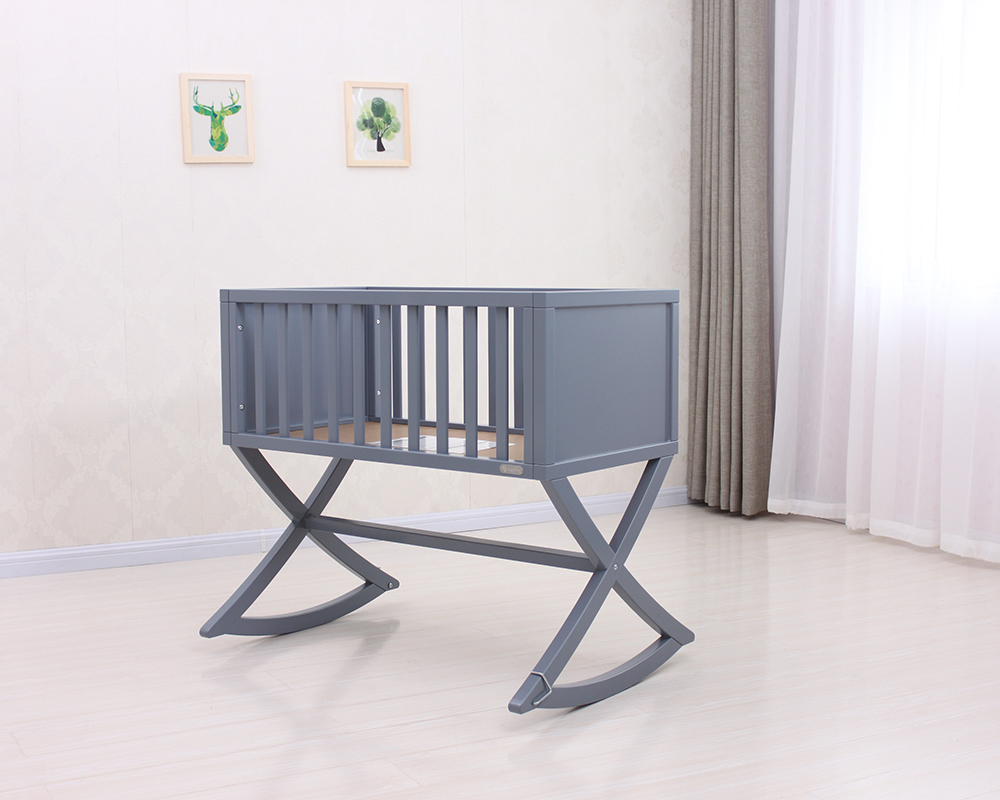
When selecting newborn sleeping furniture, parents often weigh travel models against stationary ones. Travel models prioritize collapsibility, lightweight materials, and compact folding mechanisms. Manufacturers typically use extruded aluminum frames to keep the weight under 15 pounds. To achieve this portability, they often sacrifice the large storage baskets, sturdy wooden frames, and electronic features like built-in vibration or white noise found on stationary models.
This creates a common dilemma: do you need both? For most families, buying two separate units is unnecessary. Hybrid models exist that offer a sturdy enough frame for daily home use while still featuring a quick-fold mechanism for weekend trips. If you travel frequently, lean toward a robust travel model and use it as your daily driver at home. You can easily supplement missing electronic features with a standalone portable white noise machine.
Many premium travel systems include a bassinet attachment for the stroller. Parents often hope to use this attachment indoors to save space and avoid buying additional gear. The convenience is undeniable. You can transition a sleeping baby from a neighborhood walk directly into the living room without waking them.
However, a major safety caveat exists. Not all stroller attachments are CPSC-approved for overnight, unsupervised sleep. Many are designed strictly for supervised daytime strolling. They lack the necessary breathability or structural stability for overnight use. You must meticulously verify the specific model's safety rating. If the manufacturer does not explicitly state it is approved for overnight sleep off the stroller frame, you cannot safely use it as your primary indoor sleep space. Some brands require you to purchase a separate, approved stand to make the stroller attachment safe for overnight indoor use.
Playards, commonly known as pack and plays, offer exceptional longevity. They accommodate newborns and continue to serve as safe sleep and play spaces well into toddlerhood. However, this longevity comes with significant trade-offs in footprint and daily mobility. Playards take up substantially more floor space. A standard playard measures roughly 40 inches long by 28 inches wide, making it difficult to fit next to an adult bed in a small room. They are also heavier and wider, making it nearly impossible to roll them fully assembled through standard doorways.
Many playards come with a bassinet insert. This is a raised platform that clips onto the top rails. While this saves you from bending all the way to the floor, it does not offer true household portability. It acts as a temporary raised sleeping surface within a stationary unit. If your goal is to seamlessly move the baby from the bedroom to the kitchen, a dedicated portable bassinet remains superior.
Traditional aesthetics still appeal to many parents, leading to a debate between modern mesh designs and classic wooden structures. A modern compact baby cradle typically utilizes aluminum frames and fully breathable mesh fabrics. These materials prioritize airflow, extreme portability, and easy cleaning. You can easily wipe down the metal frame and throw the mesh siding into the washing machine.
In contrast, a solid wood cradle offers unmatched heirloom aesthetics and long-term durability. However, the trade-offs are significant. Solid wood sides lack breathability. This can trap heat and pose a risk if the baby rolls against the edge. Wooden cradles are also heavy, difficult to move between rooms, and completely impractical for travel. While beautiful for a stationary nursery setup, they fail to meet modern requirements for lightweight, breathable household mobility.
Sleep Solution | Footprint | Portability | Lifespan | Best Use Case |
|---|---|---|---|---|
Portable Bassinet | Compact (Narrow) | High (Wheels/Lightweight) | 4 to 6 Months | Room-to-room mobility, bedside sleeping, C-section recovery. |
Pack and Play (Playard) | Large (Wide) | Low (Heavy/Wide) | Up to 3 Years | Stationary downstairs sleep, toddler travel, budget consolidation. |
Stroller Attachment | Varies by Stand | Medium (Requires Stroller Frame) | 4 to 6 Months | Neighborhood walks, supervised daytime naps (if CPSC approved). |
Solid Wood Cradle | Medium to Large | None (Stationary) | 4 to 6 Months | Aesthetic nursery design, stationary daytime sleep. |
When evaluating mobility, scrutinize the wheels and frame construction. Look for high-quality, rubberized casters rather than hard plastic wheels. Rubber glides silently over hardwood floors without scratching and transitions smoothly onto carpets. Mandatory locking mechanisms on at least two wheels are required to ensure the unit stays firmly in place once positioned next to your bed.
For travel-oriented models, inspect the folding joints. A reliable travel bed must have lock-in-place indicators. This is usually an audible click or a visual color change confirming the frame is fully secured. Assess the joints for pinch-points that could catch your fingers during assembly. Once fully assembled, press down firmly on the center of the mattress. The frame should exhibit zero wobble or structural bowing. The legs should have a wide enough stance to prevent tipping if a toddler leans against the top rail.
Newborn sleep spaces endure a constant barrage of bodily fluids, from frequent spit-ups to inevitable diaper blowouts. Hygiene maintenance is a daily operational requirement. The mattress pad must feature a fully waterproof encasement to prevent liquids from seeping into the core foam. Foam that absorbs moisture will quickly harbor mold and bacteria, rendering the bed unsafe.
Fabric components surrounding the sleep area should be removable and machine-washable. Spot-cleaning is rarely sufficient for heavy soiling. You will need an enzymatic cleaner to break down biological stains effectively. Furthermore, you must use only manufacturer-approved replacement sheets. Third-party sheets often fit poorly, creating loose fabric that poses a severe suffocation hazard. Always check the availability of OEM (Original Equipment Manufacturer) sheets before committing to a specific model. Buy at least three fitted sheets so you always have a clean backup during middle-of-the-night sheet changes.
Spatial logistics dictate how seamlessly a product integrates into your life. Before purchasing, measure your bedroom's bedside clearance. If you plan to use a model designed to pull up over the parent's mattress, ensure the legs can slide under your specific bed frame. Platform beds often lack the necessary clearance for these C-shaped legs. Measure your interior doorways to confirm the assembled unit can pass through without hassle.
For road trips, evaluate the folded dimensions against your vehicle's trunk space. Strollers and luggage will also compete for that area. A compact sedan trunk requires a much tighter fold than an SUV cargo area. Air travel introduces stricter logistics. Determine if the folded unit meets overhead bin requirements, which typically cap at 22 x 14 x 9 inches. If it exceeds these dimensions, it requires gate-checking. If gate-checking is necessary, a durable, padded carrying case is mandatory to protect the frame from aggressive baggage handling.
New parents frequently fall into the trap of gear redundancy. Purchasing multiple items that serve overlapping functions drains your budget and clutters your home. Buying a bedside sleeper, a separate travel crib, a stroller attachment, and a full-sized nursery crib simultaneously is a common mistake. This spatial and financial risk is entirely avoidable with strategic planning.
To mitigate this risk, identify your primary use cases before making any purchases. If you take frequent flights, prioritize an ultra-compact travel model that can also serve as your bedside sleeper at home. If you only need to move the baby from the bedroom to the living room, a sturdy wheeled model is sufficient, and you can skip the travel-specific gear entirely. Consolidate your gear based on your actual lifestyle.
Moving a baby from a cozy, enclosed space to a large, stationary crib often triggers significant sleep disruption. Infants become accustomed to the snug boundaries and specific environment of their early sleep space. Abruptly changing their environment can lead to weeks of difficult nights for the entire family.
Mitigate this risk by executing a phased transition plan. Begin by moving the portable unit into the nursery for a few nights. This allows the baby to adjust to the new room's sights, sounds, and temperature while remaining in a familiar bed. Next, introduce the full-sized crib for daytime naps only. Once the baby comfortably completes naps in the large crib, transition them for overnight sleep. This gradual approach minimizes shock and preserves the sleep habits you worked hard to establish.
A mobile infant sleep space offers immense value for parents prioritizing early-months convenience, physical recovery, and household flexibility. While the usage window is short, the intense demands of the fourth trimester make the investment highly worthwhile for most families. However, it is not strictly mandatory. If space is exceptionally tight, a standard crib or a playard can safely serve as a solitary sleep solution.
When shortlisting your options, apply a strict filtering logic. First, eliminate any product lacking current CPSC certification. Second, filter the remaining options based on your primary mobility need—whether that involves navigating airport terminals, packing into a sedan trunk, or simply rolling over hallway thresholds. Finally, make your selection based on your aesthetic preferences.
Take the following actionable steps to finalize your decision:
Measure the clearance under your bed frame and the width of your bedroom doorways to ensure physical compatibility.
Check the trunk capacity of your primary vehicle alongside your stroller to verify travel feasibility.
Search the CPSC database for recall history on any secondhand models you are considering.
Verify the availability and cost of manufacturer-specific waterproof sheets for your top choice.
A: Most babies outgrow them between four and six months of age. You must stop using the unit immediately when the infant reaches the manufacturer's maximum weight limit, usually 15 to 20 pounds. You must also stop use when the baby begins showing signs of pushing up on their hands and knees or rolling over, whichever comes first.
A: Yes, it is completely safe for overnight sleep provided it meets current CPSC safety standards. You must use the firm mattress pad provided by the manufacturer and keep the sleep space entirely free of loose blankets, pillows, bumpers, and stuffed toys.
A: You can only use it for overnight sleep if the manufacturer explicitly states the attachment is CPSC-approved for overnight, unsupervised sleep off the stroller frame. Many attachments lack the necessary breathability and structural stability for safe overnight use indoors.
A: It depends on your travel habits. Pack and plays are heavy and bulky, making them difficult for air travel or small hotel rooms. If you fly frequently or have limited trunk space, a dedicated, compact travel model is highly beneficial. For occasional road trips, a pack and play is usually sufficient.
A: Yes, but logistics vary by model. Ultra-compact models that fold down to standard carry-on dimensions can fit in overhead bins. Larger models must be gate-checked or checked at the ticketing counter. Always use a durable travel bag to protect the frame from damage.
A: Only temporarily. Cradles are designed strictly for the newborn phase. Because babies quickly exceed the weight limits and developmental milestones associated with cradles, you will eventually need to purchase a full-sized crib or a playard for their first few years.
A: Modern wooden cradles are safe if they meet CPSC standards, including appropriate slat spacing and a firm mattress. However, older heirloom furniture often fails current safety regulations. Solid wood sides also lack the breathability of modern mesh designs, which can be a concern if the baby rolls against the edge.


